

Why traditional permission models are reaching their governance limits
Traditional permission models were developed for manageable, static IT environments. However, in Microsoft 365, Entra ID, and hybrid Active Directory environments, traditional user and access management is no longer sufficient to keep access consistently controllable over time.
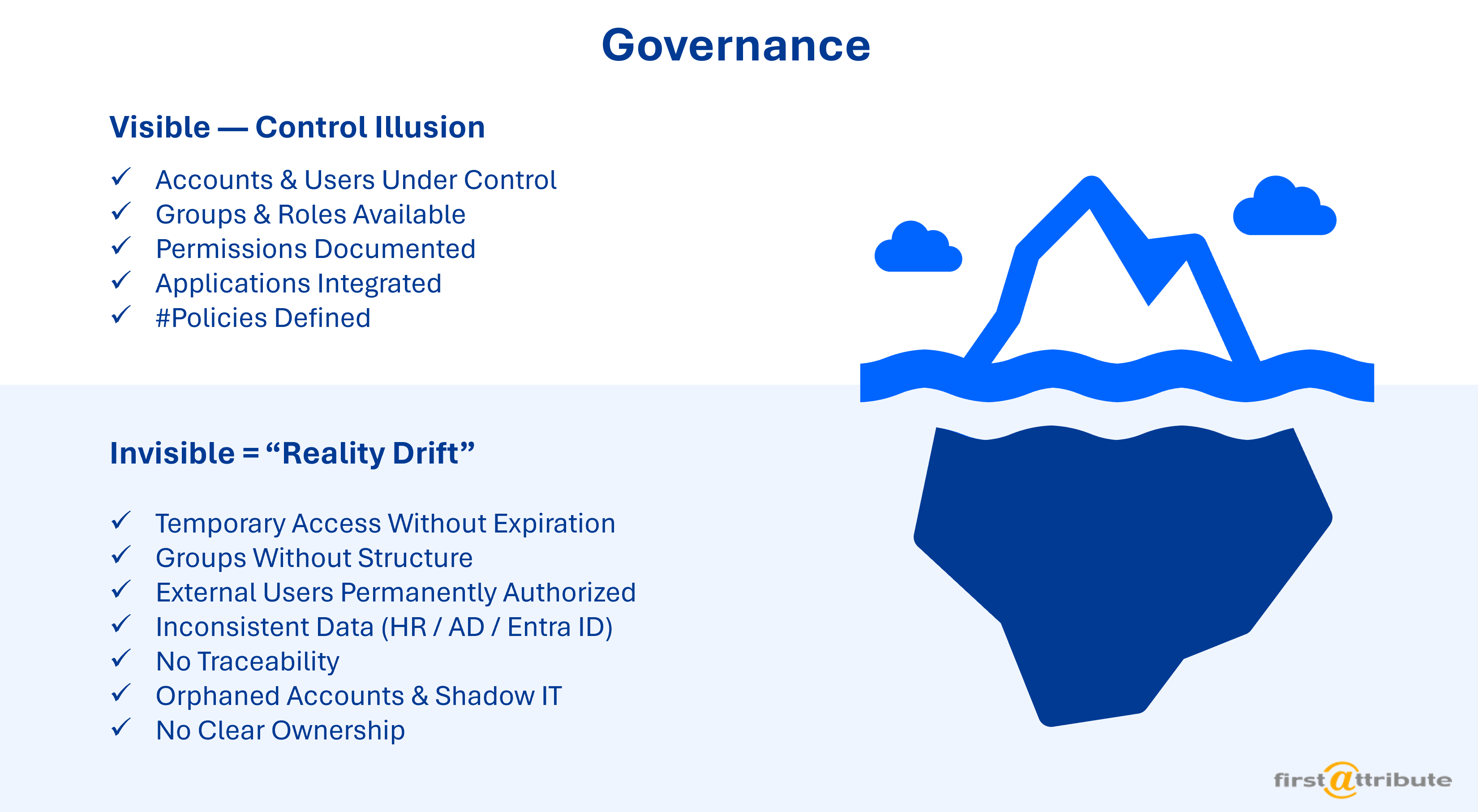
The growing distribution of identities, groups, and applications across cloud and on-premises systems causes governance models to reach their limits. Permissions are created simultaneously in multiple locations, maintained differently, and lose consistency throughout their lifecycle.
This article outlines the key structural challenges of traditional permission models and explains why consolidated approaches are becoming increasingly important in hybrid environments.
Index
Governance Gaps Between Cloud, Hybrid, and Legacy Systems
Access control describes the management, monitoring, and traceability of identities, groups, roles, and permissions throughout their entire lifecycle. In modern environments, however, this control is distributed across multiple systems.
Microsoft 365 uses Entra ID for authentication and authorization, while Azure RBAC manages access to resources. At the same time, Active Directory remains the foundation for local applications, file shares, and legacy systems.
This parallel structure means governance no longer takes place at a single central point but must instead be implemented across multiple platforms. As a result, inconsistencies emerge that are difficult to control in day-to-day operations.
Risk 1: External Identities as a Governance Risk
A central aspect of modern governance in traditional permission models is the handling of external users. In Microsoft Teams, SharePoint, and Microsoft 365, guests are quickly integrated into projects and granted access to communication and data.
The management of these external identities is handled through Microsoft Entra External ID and defined collaboration policies. These policies determine which partners are allowed and what access rights they receive.
In practice, however, external accounts often remain active longer than intended. Group memberships are rarely reviewed, and access frequently remains after a project has ended.
Effective governance and lifecycle control therefore require regular access reviews and clearly defined ownership responsibilities for external identities. Only then can organizations ensure that access remains time-limited and controlled.
Risk 2: Historically Grown Groups and Lack of Transparency
Groups are the central foundation of access control in Microsoft 365 and Active Directory. In hybrid environments, however, parallel group structures often emerge: local AD groups for traditional systems and Microsoft 365 groups for cloud collaboration.
Without centralized governance, these structures evolve independently from one another. This leads to multiple groups controlling the same access to resources or additional direct permissions being assigned.
Governance of traditional permission models therefore depends on transparency and clearly defined structures. Every group should have a defined purpose, an assigned owner, and be reviewed regularly. Access reviews and audit logs support this control but cannot replace a consistent group strategy.
Risk 3: Temporary Permissions Without Lifecycle Control
Project work, migrations, or incident response scenarios often require temporary access rights. In Azure or AWS, roles and permissions can technically be assigned with time limitations.
In reality, however, these mechanisms are not always consistently used. As a result, permissions remain active beyond their original purpose. Governance of traditional permission models therefore requires a clearly defined lifecycle for every permission. Every role or group membership should have a start date, an end date, and an assigned owner. In addition, regular access reviews provide further control over exceptions.
Risk 4: The Disconnect Between HR and IT in the Identity Lifecycle
Another major challenge in modern identity and access governance is the missing integration between HR systems and IT infrastructure. HR defines employee data such as organizational unit, role, and cost center, while IT systems use this information to manage permissions.
Without automated synchronization, inconsistent data states arise between HR, Active Directory, and Entra ID. Changes such as department transfers or employee departures are not fully reflected in the permission structure.
This leads to users retaining access to resources they no longer require from an organizational perspective. A consistent identity lifecycle therefore requires a seamless connection between HR and IT, where changes are automatically propagated to all relevant systems.
📍Learn from a real-world public sector example how to seamlessly connect HR and IT processes to significantly improve onboarding, data quality, and access governance: Connecting HR Systems and IAM: Public Sector Use Case
Risk 5: Lack of Audit-Proof Traceability
Governance of traditional permission models does not end with assigning permissions but also includes their complete traceability. Every change must be documented, attributable, and auditable.
Microsoft Entra Audit Logs and Microsoft Purview provide a technical foundation for this. Nevertheless, gaps often arise in practice when logging is incomplete or processes are not consistently integrated. In the event of a security incident or audit, it then becomes difficult to determine who made a change and on what basis it was approved.
Audit-proof governance therefore requires three key elements:
- consistent logging,
- clear process integration, and
- a centralized view of all identity and permission changes.
Consolidated Governance with IDM-Portal
The IDM-Portal consolidates identity and group data from directories, HR systems, and cloud applications into a centralized governance layer. This creates a unified view of all identities and permissions across system boundaries.
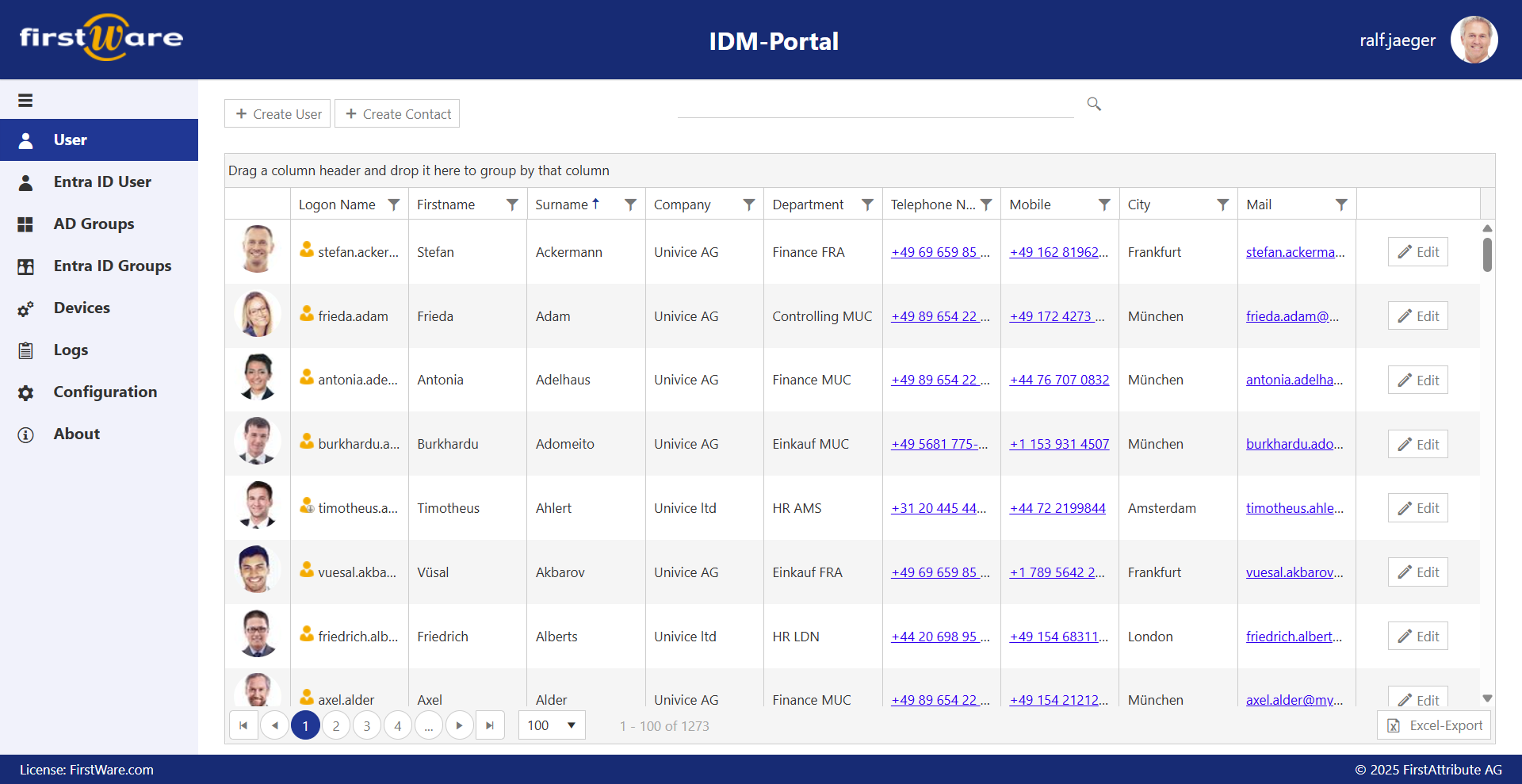
Identity Governance is therefore no longer implemented separately across individual tools but orchestrated centrally. Lifecycle processes such as onboarding, offboarding, and changes are automated and synchronized back to connected systems.
Access reviews and approval workflows follow a unified access governance model. Every identity and every group has a clearly defined owner and lifecycle policy. 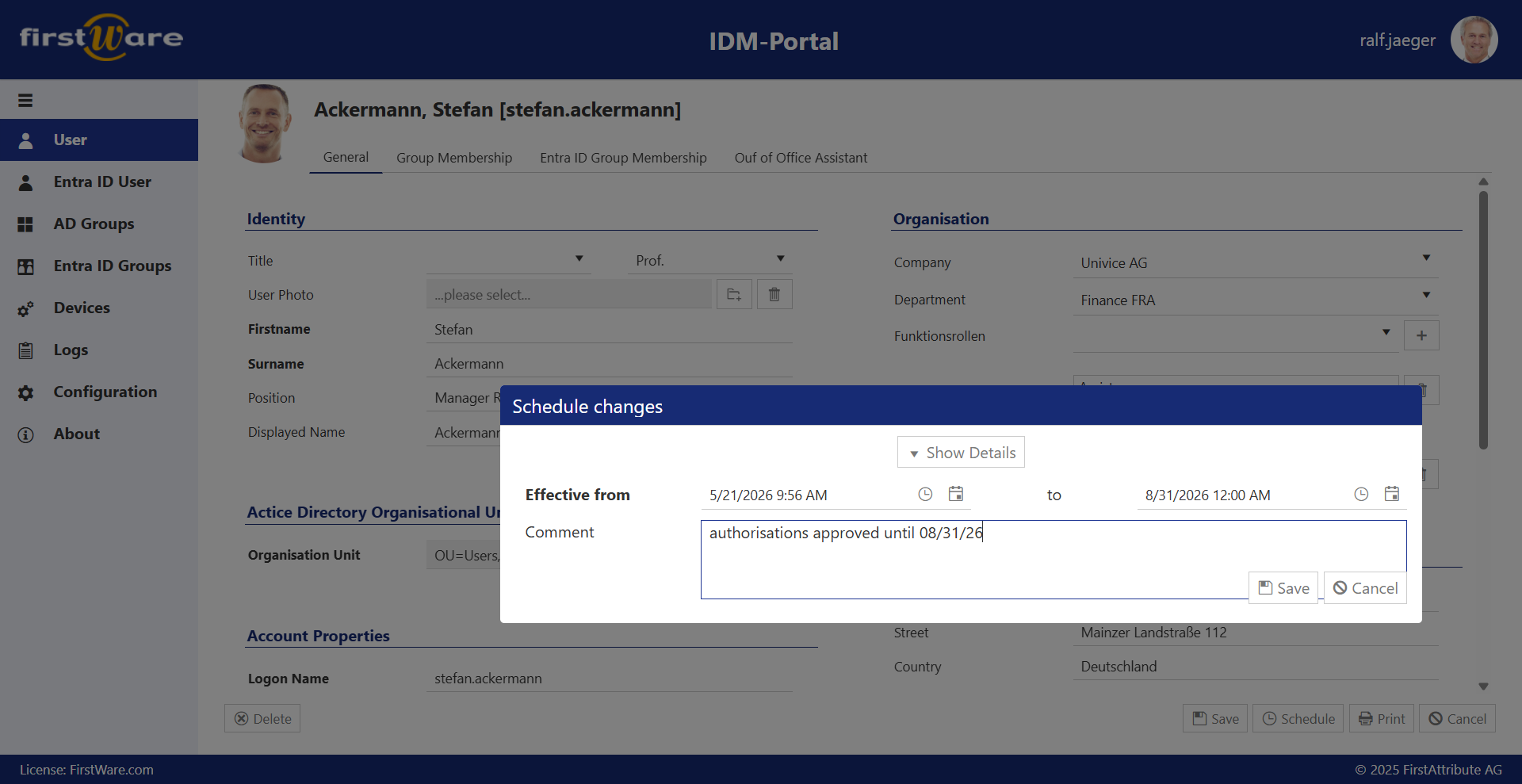
The result is end-to-end access governance across all systems: less manual administration, fewer shadow structures, and significantly greater control over the entire identity lifecycle.
Conclusion
Governance of traditional permission models in hybrid IT environments is not purely a technical issue but a combination of processes, data quality, and system integration. The greatest challenges arise where identities, groups, and permissions are distributed across multiple systems without centralized governance.
A consolidated approach reduces this complexity and enables governance throughout the entire lifecycle. This makes access traceable, consistent, and controllable — regardless of cloud, directory, or application environments.
Learn More About FirstWare IDM-Portal
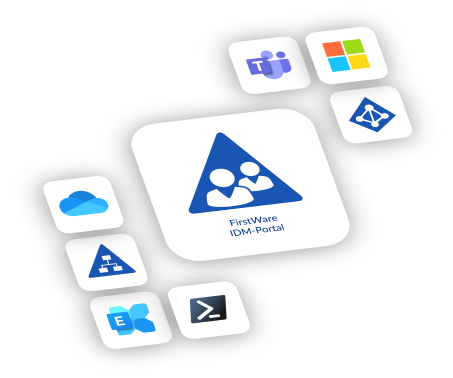 The FirstWare IDM-Portal by FirstAttribute is an integrated Identity and Access Management (IAM) solution that enables the automated management of users and permissions, whether on-premises or in the cloud.
This portal integrates all aspects of Identity and Access Management and provides centralized access to identity and directory services.
