

Connecting HR Systems and IAM: a practical case in the public sector
How long does onboarding take in your organization? Days? Weeks? It doesn’t have to be that way.
A public administration with around 1,000 users faced exactly this challenge: accelerating the onboarding of new employees and making user management significantly more efficient for IT and HR departments.
The solution was connecting the HR system to the IAM via IDM-Portal to avoid duplicate data entry, enable decentralized workflows, and increase data sovereignty.
Learn how you can solve similar challenges in your organization.
Index
Why HR systems and IAM belong together
In many organizations, onboarding starts in two different places:
- HR department: creates new employees in the HR system and maintains master data.
- IT department: simultaneously creates user accounts in the IAM system.
This leads to duplicate data entry, media disruptions, and manual exchange via email or paper.
Consequences: Incorrect data, high time expenditure, lack of transparency.
The key question: How can HR systems be efficiently connected with Identity and Access Management systems (IAM) to automate onboarding and permission management?
The old process: slow, error-prone, person-dependent
Before integration, user attributes were maintained by IT, while HR kept its own data up to date. Data was exchanged via email or printed documents between HR and IT.
Result: Delays due to vacation cover, sick leave, or typos led to inconsistent data and long processing times. Adjustments often took several days, and IT was heavily burdened.
This classic media break (HR system → email → IT → directory) brought risks and missed opportunities:
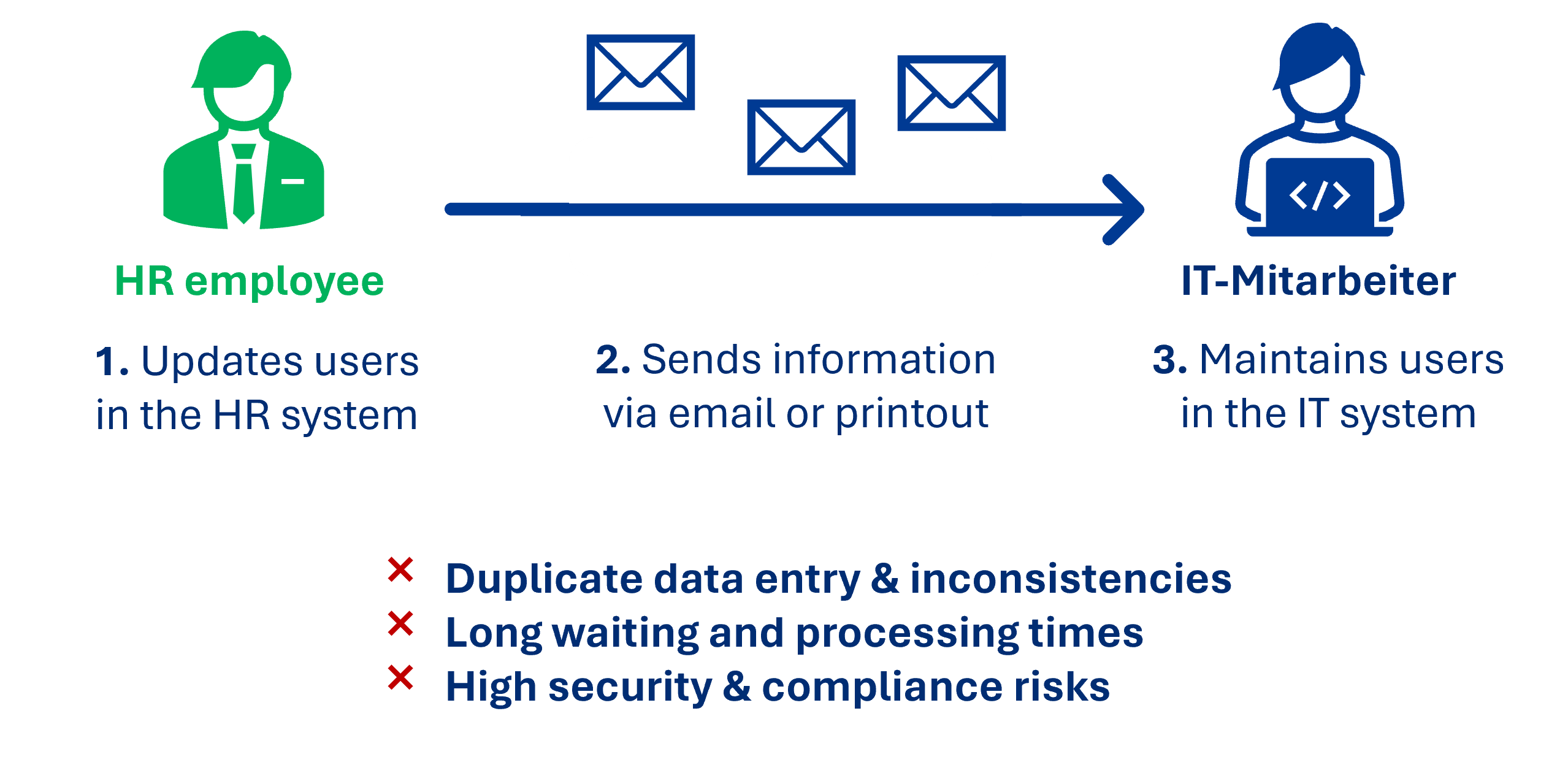
The solution: automated HR system integration in the IAM system IDM-Portal
The administration opted for HR system integration with the IAM system IDM-Portal.
>>The core idea: Daily exports of HR data, automated processing, and direct synchronization with the IAM system without manual intervention.
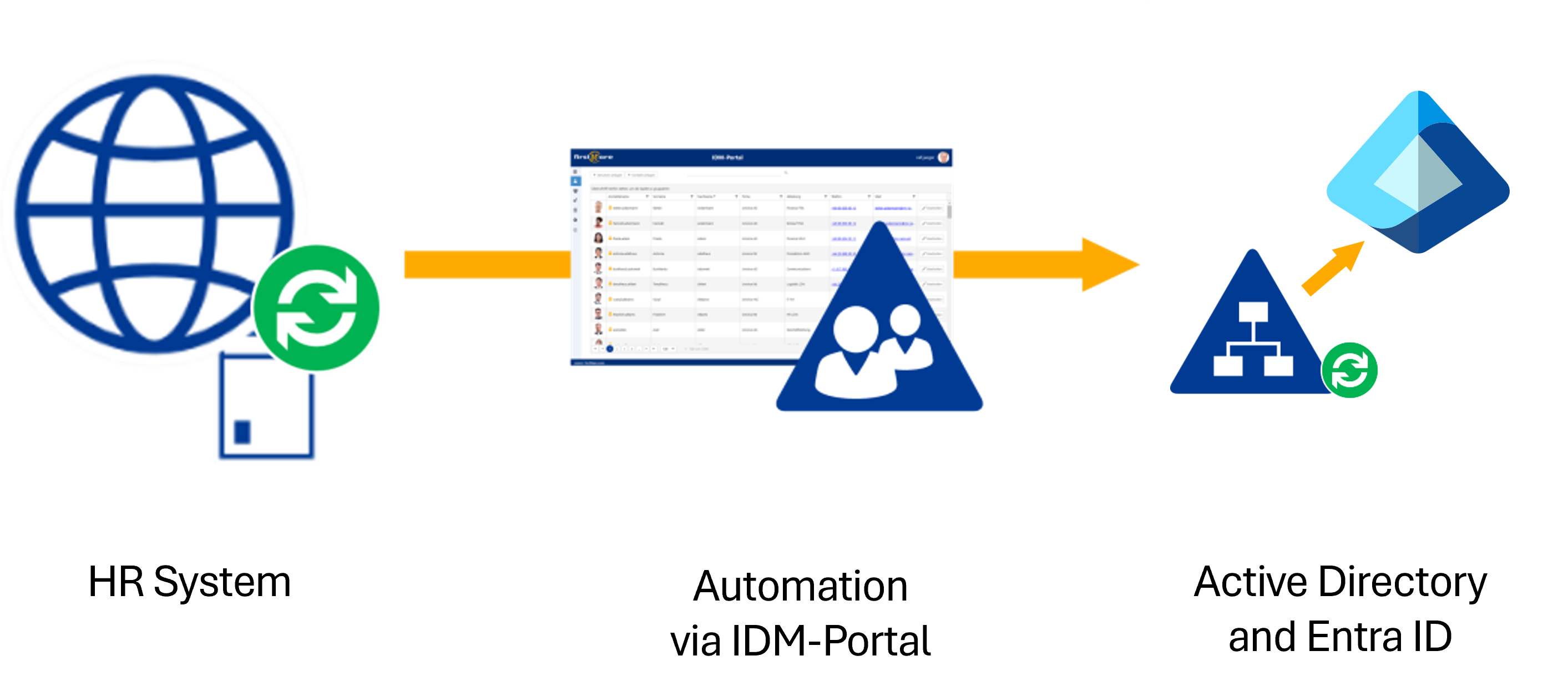
Technical process
- Nightly full export from the HR system
- Automated processing in IDM-Portal
- Addition of extra columns for automation
- Delta comparison to detect changes
- Import of the finished CSV file into IDM-Portal
- Automatic update of IAM data
The result: A seamless, error-reduced process that speeds up onboarding, ensures data quality, and relieves the IT department.
Would you like to make your onboarding processes just as efficient?
Role model: IT, HR, and managers
The integration takes different responsibilities into account:
- IT department: Operational use of IDM-Portal, technical control, monitoring
- HR: Maintenance of defined attributes (name, first name, department, extension attributes), sending information emails, notifications, and password letters if necessary
- Managers: Limited changes, e.g., approval of certain updates
This role model ensures that departments can complete their tasks independently while IT retains governance.
IDM-Portal: More than just synchronization
The benefits of IDM-Portal go far beyond simple data transfer. Once master data such as first name, last name, and department are maintained, numerous other IAM information updates automatically, such as email addresses, manager assignments, work locations, or license allocations.
Example: If an employee’s department changes, IDM-Portal not only updates the master data but also group memberships, managers, and addresses.
The result: No manual follow-up, consistent data across all systems, and maximum efficiency for IT.
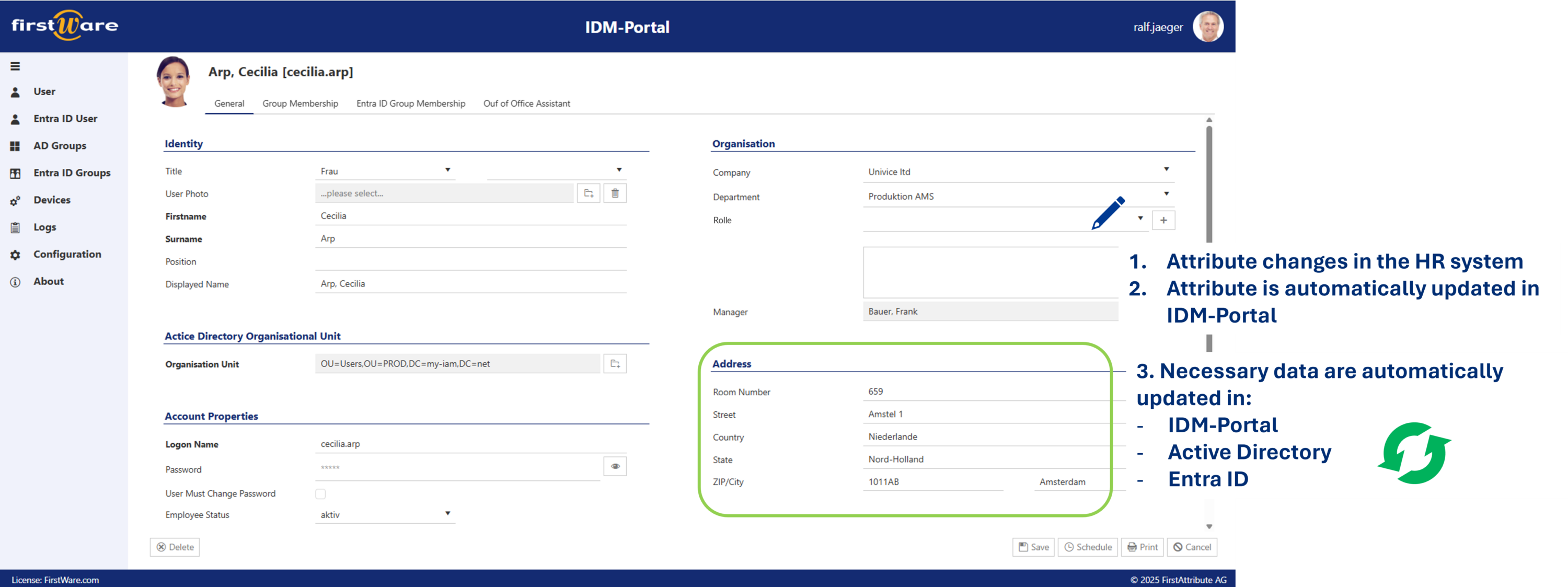
Bulk Updates: Efficiently Manage 1,000 Users
A key highlight of the integration is its flexibility: On-demand bulk updates can be performed at any time via CSV file. This allows large volumes of changes or new users to be quickly and automatically imported into the IDM-Portal without manual rework.
Lessons Learned: What IT Leaders Can Take Away from This Project
This project impressively demonstrates how HR systems and IAM solutions can work together seamlessly in the public sector without compromising security or governance. Automation not only drives efficiency but also frees up time for strategic IT tasks.
Why is this relevant for you?
- Less manual work, more control: Bulk updates and delta checks reduce errors and speed up processes.
- Transparency and compliance: Role and rights management is clearly defined. Governance remains in your hands.
- Simplicity despite complexity: CSV-based synchronization maps even complex workflows with ease.
- Onboarding reimagined: Fast, secure, and traceable – a real competitive advantage for your organization.
Conclusion: Integrating HR and IAM not only saves time but also improves quality and security.
Conclusion: Connecting HR Systems and IAM as a Strategic Advantage for the Public Sector
This project shows how we can successfully connect HR systems and IAM. The integration significantly reduces administrative effort, accelerates onboarding processes, and improves data quality.
For public organizations, this means: stable and secure processes, fewer risks, higher efficiency, and complete transparency. This practical example proves that automation, role management, and bulk import go hand in hand, ensuring governance and compliance at all times.
Are you ready to connect HR and IAM in your organization? We’ll show you how.
Learn More About FirstWare IDM-Portal
 The FirstWare IDM-Portal by FirstAttribute is an integrated Identity and Access Management (IAM) solution that enables automated management of users and their permissions, whether on-premises or in the cloud.
This portal integrates all aspects of identity and access management and provides centralized access to identity and directory services.
