

Digitalize onboarding process: Efficiently managing new hires
In healthcare, time is a critical factor, not only in patient care but also in administrative processes. Especially when onboarding new staff, from specialist physicians to trainees, an inefficient onboarding process can consume significant time and resources.
In this project, we demonstrated to a hospital how the use of our IDM-Portal can significantly simplify and accelerate the entire workflow, from HR registration to the provision of IT access.
Index
The Challenge: High employee turnover
Our customer, a regional hospital with around 2,000 employees, faced the challenge that the high number of new hires, from permanent staff to contract physicians and trainees, required a fast and seamless onboarding process.
Up until now, these processes were documented in a Word file that HR, IT, and the departments had to complete sequentially and ultimately have approved by a senior physician. Naturally, this procedure was outdated, error-prone, and time-consuming.
📩 The customer approached us with the request to
- digitize,
- standardize, and
- automate
- the entire onboarding process without overwhelming users with the interface.
Our solution: clear, time-saving onboarding
Using the IDM-Portal, we digitally mapped the existing process one-to-one, including all notifications and roles. This required close cooperation with the hospital’s administrators, who were actively involved from the beginning.
This is how the new workflow operates:
- HR creates the user: With one click on “Save,” the IT department is automatically notified.
- Notification of other departments: Telephony services and the department head also receive a notification to add the required information.
- User activation: The department sends the new employee their password and sets the account to “active.”
- Final review by IT: The IT department receives the final notification and can review the permissions.
User involvement
A key element of this project was the involvement of various stakeholders.
HR, department managers, IT, telephony services, and the on-call IT team—all of them now use the portal.
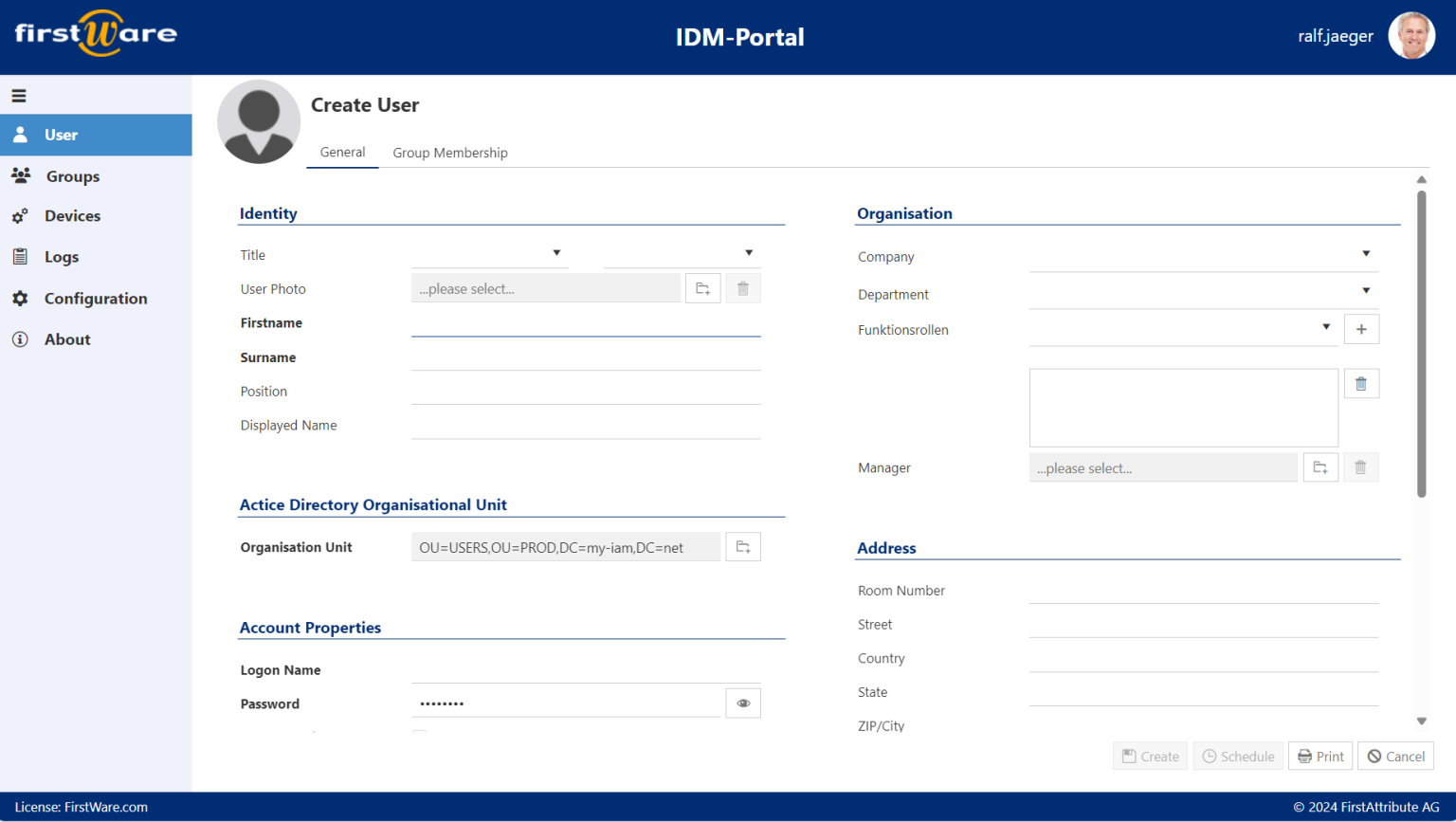
The role concept in the IDM-Portal makes it possible to use different views for reading and/or editing.
Delegation is the heart of the IDM-Portal:
- Let tasks be completed where they belong. HR, IT, or department teams carry out exactly the steps they need—without administrators having to perform every action themselves.
- Everyone sees only what they need. Through role-based access (RBAC), users see exactly the functions and data relevant to their task.
- Simple, intuitive interface—even for non-technical users. The IDM-Portal is designed so that even users without deep IT knowledge can handle routine tasks themselves (e.g., creating users, maintaining profiles, managing groups).
At the same time, everything is traceable and flexible: Roles and permissions can be assigned temporarily and revoked automatically.
Results and Feedback
By digitizing the onboarding process, the customer significantly increased process efficiency:
✅ All participants now work via a unified, intuitive interface that is modeled after the familiar Word document (ensuring high user acceptance). In addition, the customer uses the Automation Service in the IDM-Portal to efficiently manage scheduled actions and data imports.
User creation is now faster, and departments can complete tasks independently. Administrators and the on-call IT team particularly appreciate the intuitive interface, which simplifies their work and offers transparency and traceability. Initial feedback shows that users find the new solution much simpler and more practical than the previous Word-based method.
The IDM-Portal acts as a central hub for HR, IT, and departments—an important step toward modern, automated identity management within the hospital.
Learn more about FirstWare IDM-Portal
 The FirstWare IDM-Portal from FirstAttribute is an integrated Identity and Access Management (IAM) solution that enables the automated management of users and their permissions—whether on-prem or in the cloud.
The portal integrates all facets of identity and access management and provides centralized access to identity and directory services.
